
Media Corner
“A high-performance leader is different from a high-performance individual”
~ Ram Charan
When the CEO of a large manufacturing enterprise announces his premature retirement, the succession discussion begins almost immediately. There is no shortage of names. One candidate has spent two decades with the company and enjoys enormous credibility with the board. Another has delivered exceptional business results but has spent most of her career in a single function. A third, considerably younger, has quietly led some of the organisation’s most difficult transformation initiatives and built influence well beyond her formal remit.
The leadership team weighs experience, performance, managerial capability and business familiarity. Eventually, someone says, “I think he is the safest choice.” The room nods.
There is nothing unusual about this conversation. In fact, it is remarkably close to how succession decisions are made in many organisations. The problem is not that experienced leaders are incapable of making sound judgements. It is that succession is one of the areas of HR where human judgement is particularly vulnerable to incomplete information, personal familiarity and unconscious bias. That makes objectivity one of the biggest unfinished challenges in succession planning.
The stakes are considerable.
McKinsey’s analysis has found that between 27% and 46% of executive transitions are viewed as failures or disappointments two years later. *
Technology has already brought discipline to the process. Modern HCM platforms can bring performance history, competencies, learning, career movement and talent assessments into a common environment. Organisations can create talent pools, define readiness levels and build development plans rather than relying entirely on spreadsheets and institutional memory.
Yet digitising a process does not necessarily make it objective. If the information entering the system is shaped by managerial preferences, historical opportunity or inconsistent assessments, technology can simply make an existing process more efficient.
This is where Artificial Intelligence could represent a more meaningful change.
Consider the three candidates in our hypothetical organisation. A conventional succession review might give considerable weight to tenure, current performance, leadership experience and recommendations from senior managers. An AI-enabled system could examine a much broader range of signals: skills acquired, learning velocity, project complexity, cross-functional exposure, career aspirations, internal mobility and performance trajectories.
The younger transformation leader might suddenly look different through that lens. She may not have managed the largest team or spent the longest time in the organisation, but the data could reveal a consistent pattern: she has repeatedly taken on unfamiliar challenges, acquired adjacent capabilities, influenced people outside her reporting structure and performed well amidst ambiguity.
AI has not discovered the next CEO. It has simply brought more evidence into a decision that previously depended heavily on visibility and perception.
That matters because leadership potential rarely arrives with a title. It often appears first as a pattern of behaviour. The broader talent picture makes this challenge even more pressing.
Gartner reports that 72% of HR leaders struggle to close successor capability gaps, while only 38% of CHROs are confident they can deliver their succession-management goals over the following year. (**)
Deloitte’s 2025 Global Human Capital Trends research found that 66% of managers and executives believe most recent hires are not fully prepared for their roles, with lack of experience the most common shortcoming. (***)
The takeaway here is significant: organizations cannot afford to sit back and wait until leadership readiness becomes self-evident. Instead, they need a clearer, deeper understanding of how that capability is evolving.
Succession Planning, therefore, needs to move beyond asking who is ready today and begin asking who is demonstrating the trajectory to become ready tomorrow. AI can help make that shift possible by continuously connecting signals that might otherwise remain scattered across performance reviews, learning systems, projects and career histories.
There is, however, a paradox. We are turning to AI to make talent decisions more objective even though AI learns from data generated by organisations and their people. If some employees historically received better assignments, greater exposure to senior leaders or more favourable ratings, those patterns can enter the dataset. If previous promotions consistently favoured a particular leadership profile, an algorithm could reinforce that definition.
This is why responsible AI in Succession Planning must begin with questions about the quality of talent data. Are performance assessments calibrated consistently? Are different career paths being valued fairly? Are aspirations being captured rather than assumed? Are informal leadership behaviours recognised alongside formal managerial responsibility? Are we assessing future potential, or are we just rewarding people for past visibility?
These are not technology questions; they are questions of HR governance.
LinkedIn’s 2025 Workplace Learning Report found that only 36% of organisations qualify as “career development champions”. Among them, 51% describe their organisations as leading or accelerating in generative AI adoption, compared with 36% among organisations with weaker career-development programmes. LinkedIn calculates that career-development champions are 42% more likely to be AI frontrunners. (LinkedIn Business Solutions)
That connection is significant for Succession. A strong leadership pipeline cannot be built just by identifying people who appear ready. It must continually generate opportunities for people to develop the capabilities that future roles will demand.
This also changes the role of HR. The best AI-enabled Succession process will not present leadership teams with a definitive ranking and ask them to approve it. It will provide evidence and patterns and allow leaders to interrogate them.
AI can identify a pattern. The organisation must understand the context behind it.
The future of Succession Planning, therefore, is not AI replacing human judgement but AI making human judgement more evidence-led. The technology can analyse thousands of workforce signals, challenge assumptions and bring overlooked talent into the conversation. HR and business leaders must still determine whether those signals make sense within the organisation’s strategy, culture and realities.
The objective should not be an AI-generated list of successors. It should be a succession process in which fewer people are overlooked because they lacked visibility, fewer decisions are driven by familiarity, and leadership potential is assessed against a broader body of evidence.
The next leader may already be somewhere inside the organisation. The competitive advantage may lie in identifying that person before the title, visibility and conventional markers of leadership make the answer obvious. That is where AI can make Succession Planning genuinely more objective – not by taking the human out of the decision, but by ensuring the human decision is made with far more of the picture in view.
}', 15='{type=string, value=https://sightsinplus.com/hrtech/artificial/ai-and-the-new-science-of-succession-planning/}'}The unified, AI-enabled HCM platform will harmonize HR across 9 entities and 300+ locations, creating a connected foundation for smarter talent management.
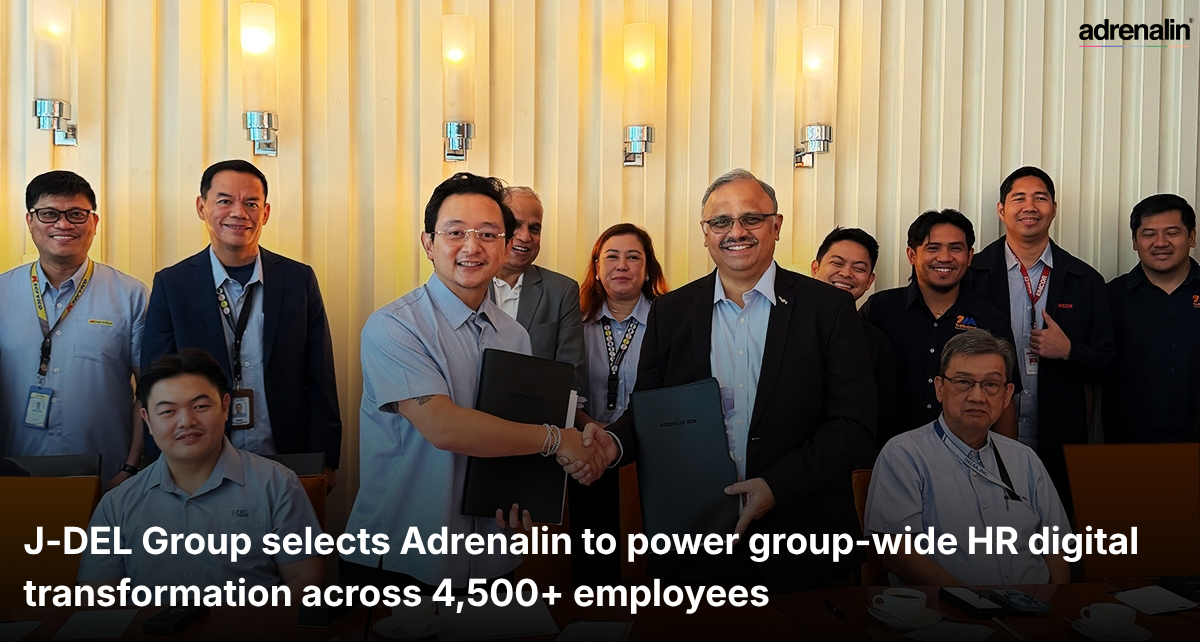
MANILA, Philippines, J-DEL Group has selected Adrenalin eSystems to support a group-wide HR digital transformation spanning more than 4,500 employees across 9 business entities and over 300 locations in the Philippines.
The initiative is a major upgrade from J-DEL Group’s current HR systems, expanding beyond attendance and payroll to a more complete Human Capital Management (HCM) platform. It will bring HR processes together across the Group—J-DEL, JVR Foundation, DELSA, Trimotors, Wodel, EMCOR, CTFSI, KServico, and KS Prime, while still allowing each company the flexibility to meet its own operational needs.
J-DEL Group will leverage Adrenalin Max HCM to create a connected talent journey covering talent acquisition, development, operations, remuneration and engagement bringing key human capital management processes onto a common digital platform.
The transformation is designed to improve Group-wide workforce visibility, standardize HR workstreams and process flows, strengthen payroll and compliance controls, and provide employees and managers with a simpler and more consistent digital HR experience. It will also provide leadership with more timely workforce information to support people and business decisions.
“This investment is ultimately about our people and the future of the J-DEL Group,” said Jorge Vicente D. del Rosario, Vice Chairman, J-DEL Group. “As our businesses continue to grow, we also need to strengthen how we manage, support and develop our employees. Adrenalin is a major step forward for us, not simply because it gives us a new system, but because it provides a stronger platform to help our people and our businesses grow together.”
“As we looked for the right upgrade to our existing HR system, we wanted a platform that could support our growing and evolving needs across the Group. Adrenalin gives us a stronger and more scalable digital foundation for the future,” said Abet Cabungcal, Group Chief Information Officer and DPO, J-DEL Group.
“Our goal is to build a stronger and more unified HR across the J-DEL Group, with consistent people practices, simpler processes, and a better employee experience. Adrenalin will help us bring these together through one integrated HCM platform,” said Oneil R. Santa Cruz, Group Chief People Officer, J-DEL Group.
Beyond digitizing today’s HR processes, the platform will create the foundation for J-DEL to progressively adopt AI across the talent journey. Adrenalin’s AI-first A.D.O.R.E talent architecture spans Talent Acquisition, Talent Development, Talent Operations, Talent Remuneration and Talent Engagement, with native AI capabilities designed to assist HR teams, managers and employees across these stages in the employee lifecycle.
“J-DEL’s transformation reflects an important shift among distributed enterprises: the objective is to go beyond HR automation and connect people, processes and intelligence across the enterprise,” said Srinivasa Bharathy, Managing Director & CEO, Adrenalin eSystems. “We are delighted to partner with J-DEL in building a unified digital HR foundation that can serve their workforce today and provide the architecture for AI-assisted HR experiences in the future.”
About J-DEL Group
J-DEL Group is a diversified Philippine business group with interests spanning retail, consumer financing, automotive assembly and distribution, HVAC and refrigeration, insurance, and related services. Through its operating companies, the Group has more than 4,500 employees across over 300 locations nationwide.
J-DEL Investments & Management Corp. provides Group-wide strategic management, governance, finance, HR, IT, and digital transformation services.
About Adrenalin eSystems
Adrenalin is a global Human Capital Management (HCM) platform serving 2,000+ enterprises across 70+ countries and empowering connected talent journeys for over 3 million employees. With 25+years in HR Technology domain, the platform is designed for enterprise scale unifying Talent Acquisition, Talent Development, Talent operations, Talent Remuneration (Payroll) & Talent Engagement in a single system.
With faster time-to-value, deeper configurability, and an intuitive UX, Adrenalin enables HR leaders to leverage intelligent automation and embedded AI agents to digitalise HR processes, enhance compliance, and accelerate decisions for business impact. By connecting talent data across the employee lifecycle, the platform helps organisations deliver consistent, compelling employee experiences worldwide. For more information, visit https://www.myadrenalin.com/
}', 15='{type=string, value=https://www.einnews.com/pr_news/944807839/j-del-group-selects-adrenalin-to-power-group-wide-hr-digital-transformation-across-4-500-employees}'}1. Where companies get employee engagement wrong and how a modern HCM platform can close the feedback-action gap
The fundamental mistake is treating engagement as an annual measurement exercise rather than a continuous management discipline. Employees do not disengage because a survey was not conducted; they disengage when they repeatedly see that their feedback does not result in visible change.
The scale of the challenge is clear. Gallup’s State of the Global Workplace 2026 reports that only 20% of employees globally were engaged in 2025, with low engagement estimated to cost the global economy $10 trillion in lost productivity. That tells us engagement is no longer an HR metric alone; it is a business-performance imperative.
Many organisations collect rich sentiment data, create dashboards, and stop there. A modern HCM Platform must close that loop. It should identify patterns, surface root causes, and trigger contextual actions for managers: a workload review where stress is rising, a career conversation where growth sentiment is falling, or a recognition nudge where teams feel invisible.
The real measure of engagement is not the score on a dashboard. It is the speed, relevance and credibility of the organisation’s response.
2. AI, early-warning signals, and effective interventions
AI can help make employee experience proactive rather than reactive. Burnout, disengagement and attrition rarely emerge from a single signal. They appear through patterns: persistent workload intensity, declining participation, unused leave, lower learning activity, unresolved manager check-ins, falling sentiment, or stalled career movement.
An AI-first HCM platform can connect these signals at an aggregate or team level and alert leaders to where support may be needed. But this must be done with privacy, consent, transparency and human oversight at its core. The purpose is not surveillance; it is early support.
This matters especially for managers. Gallup found global manager engagement fell to 22% in 2025, down from 27% the previous year. When managers themselves are stretched, the quality of coaching, recognition and team connection inevitably suffers.
The most effective interventions remain deeply human: a timely manager conversation, reprioritising work, creating clarity of role, offering flexibility, enabling a career discussion, or connecting people to wellbeing resources. AI can identify the moment that matters; empathetic leadership determines what happens next.
3. The most overlooked stage of the employee lifecycle
Organisations invest heavily in attracting talent and increasingly in onboarding it. Yet the most overlooked stage is often internal growth and mobility - the period after an employee has settled in but before they begin looking outside.
Employees do not always leave because they dislike the organisation. Often, they leave because they cannot see their next chapter within it. They may not know which internal roles are available, what skills are needed to progress, or who can help them get there.
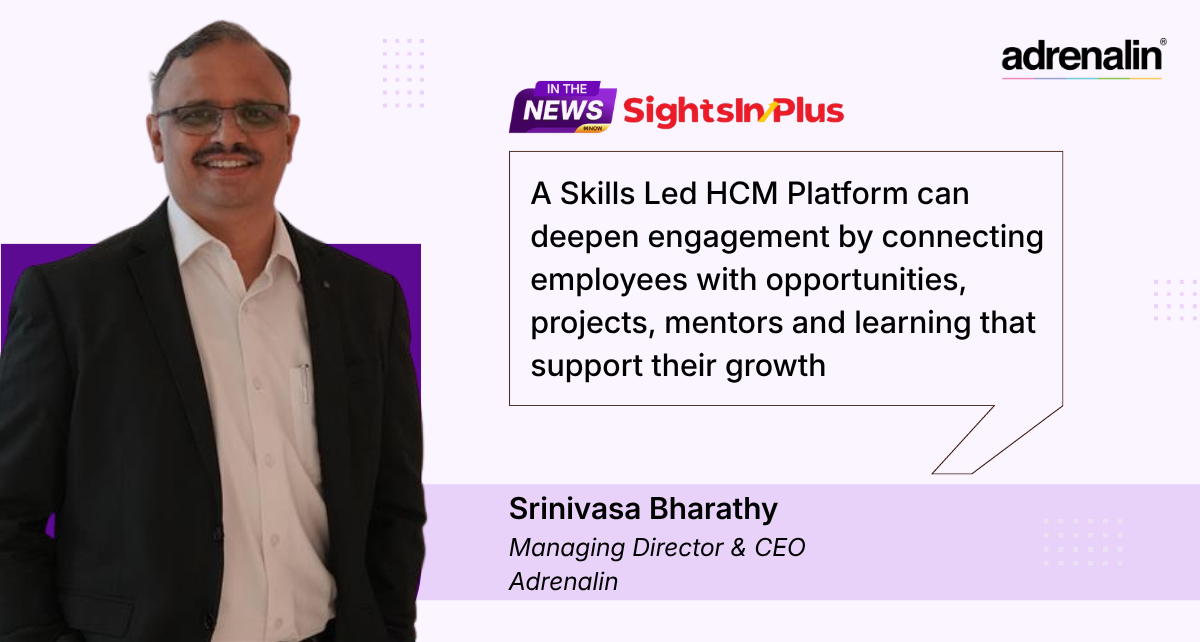
A skills-led HCM Platform can change this by creating an internal talent marketplace; matching employees to open roles, short-term projects, mentors and personalised learning pathways. It can answer three questions every employee is asking: Where am I today? What do I need next? What opportunities can I access here?
This is not merely a retention initiative. Gallup’s research shows that highly engaged teams outperform lower-engagement teams on core outcomes including profitability, productivity, absenteeism and customer loyalty. Internal mobility is where employee aspiration and organisational capability meet.
4. Evolving HRMS HCM platforms for a Gen Z workforce
Gen Z is not asking for superficial digital experiences. They are asking for transparency, agency, immediacy and meaningful growth. They expect workplace technology to be as intuitive and personalised as the technology they use in daily life.
For HCM platforms, that means moving beyond transactional self-service. The experience must offer personalised learning, clear skills visibility, regular feedback, peer recognition, accessible career pathways and relevant opportunities delivered at the right moment.
The case for this is compelling: Gallup reports that only 46% of employees globally clearly know what is expected of them at work. For a generation that values clarity, purpose and continuous development, ambiguity is not simply frustrating; it is disengaging.
Annual appraisals alone are increasingly inadequate. The future belongs to platforms that enable frequent, meaningful conversations between employees, managers and mentors. Technology should make development more continuous, but it must also preserve fairness, inclusion and trust.
5. Three employee-experience metrics beyond engagement scores
Beyond engagement scores, I would focus on three metrics.
First, internal mobility and career velocity: how effectively employees move across roles, projects and learning opportunities. This reveals whether the organization is truly developing its people.
Second, manager effectiveness: the consistency and quality of goal-setting, feedback, recognition and development conversations. Managers are the pivotal translators of culture into day-to-day employee experience.
Third, regrettable attrition risk: not simply who leaves, but which critical roles, skills and employee segments are vulnerable and why.
HR technology becomes strategic when it connects these insights to business outcomes. Gallup’s analysis shows top-quartile engagement teams deliver 23% higher profitability than bottom-quartile teams. Better mobility lowers external hiring dependence; stronger managers improve productivity and retention; earlier risk signals protect business continuity and institutional knowledge.
The aim is not to create more HR data. It is to turn people intelligence into better business decisions.
Final comments
For enterprise businesses, employee experience must be viewed as a measurable driver of growth, resilience and operating performance not as a standalone HR programme.
The outcomes are tangible: stronger employee experience can improve productivity, reduce regrettable attrition, accelerate internal mobility, strengthen leadership pipelines and enhance customer outcomes. Gallup’s research has consistently shown that highly engaged business units outperform lower-engagement teams, including delivering 23% higher profitability.
The opportunity for enterprise HR is to build an intelligent, connected people ecosystem where workforce data, skills intelligence, manager effectiveness and employee sentiment come together in real time. This enables leaders to make earlier, more confident decisions: deploy talent where it is needed, address emerging workforce risks, build future-ready capabilities and create a more agile organisation.
The future will belong to enterprises that do not merely digitise HR processes, but use technology to convert people insights into sustained business advantage in addition to keeping talent at the centre of HR operations.
}', 15='{type=string, value=https://www.sightsinplus.com/interview/chro/srinivasa-bharathy-on-complete-people-experience-beyond-ex/#google_vignette}'}At 11:47 PM on a Thursday, Anika sat alone in her apartment in Bengaluru, staring at her laptop screen. Three hours earlier, a critical customer escalation had exploded inside her company’s global operations dashboard. Revenue risk. Angry client. Leadership panic. Within minutes, teams across Singapore, Frankfurt, and Chennai jumped onto a war-room call.
Anika was not the senior-most person in the room. She wasn’t even supposed to be on the call.
Amidst the noise, confusion, and managerial posturing, she quietly used an AI-assisted workflow she had been experimenting with for weeks. In less than forty minutes, she identified the root cause and simulated three potential recovery paths using AI. But the breakthrough did not come from the machine. It came from her ability to interrogate its suggestions, filter signal from noise, and adapt the recommendations to the realities of the business. By combining computational speed with human judgment, she crafted a response that enabled the team to avoid what could have escalated into a multi-million-dollar loss.
The call ended with exhausted relief. Someone from leadership typed into the chat:
“Fantastic save, team. And good job, Anika.”
And that was it.
The next morning, Anika logged into work as though nothing extraordinary had happened. No recognition. No visibility. No differentiated reward. No system is intelligent enough to identify what had actually occurred.
Six months later, during her performance review, her manager vaguely remarked:
“You’ve been consistent this year.”
Consistent.
That single word may perfectly summarize the crisis facing modern rewards and recognition systems. Because in the age of AI, work is no longer consistent. It is fluid, spontaneous, non-linear, and increasingly invisible. And often, the employees creating the highest impact are doing so in moments traditional HR systems were never designed to detect.
For decades, organizations operated on the assumption that value could be measured slowly. Annual reviews, quarterly incentives, bell curves, and delayed bonuses all emerged from a world where work itself moved methodically.
But AI has shattered the time horizon of contribution.
Today, an employee armed with intelligence augmentation tools can create extraordinary business value in a single afternoon. A junior analyst can automate what once took a team of ten. A customer support executive can resolve complex escalations using AI tools in minutes. Meanwhile, the reward systems surrounding them still move at the speed of paperwork. Employees feel that disconnect deeply.
One young product manager recently described it bluntly during an internal listening session:
The company sees my attendance in real time, my productivity in real time, my response time in real time… but somehow my contribution is visible only once a year.
That sentence should make every HR professional uncomfortable.
Employees are no longer comparing workplace experiences with other companies alone. They are comparing them with the responsiveness of the digital world itself. Every app they use delivers instant feedback, recognition, recommendations, or rewards.
One of the most misunderstood aspects is this: AI is not merely changing productivity. It is changing the very shape of contribution.
Today, enormous outcomes may emerge from moments of creativity, insight, orchestration, or intelligent prompting.
And here lies the irony.
As work becomes more intelligent, contribution becomes less visible to traditional management systems. This is where a new idea is beginning to emerge within progressive HR tech circles: Contribution Intelligence.
Imagine systems capable of identifying who solved the bottleneck, who accelerated collaboration, who prevented a customer churn event, who unlocked innovation velocity, or who quietly amplified team performance without demanding visibility.
Years ago, rewards were primarily economic. Today, they are deeply psychological. Employees increasingly want to know: “Did the organization notice what I did?”
A senior engineer from a Manufacturing major recently shared something fascinating:
“Honestly, it’s not even about the money anymore. It’s about whether the company’s systems are intelligent enough to understand where value is really being created, without any bias.”
Recognition is becoming less transactional and more reflective. Employees are asking whether the organization truly sees the reflection of their contributions. And strangely enough, AI may become the very thing that restores humanity into recognition systems.
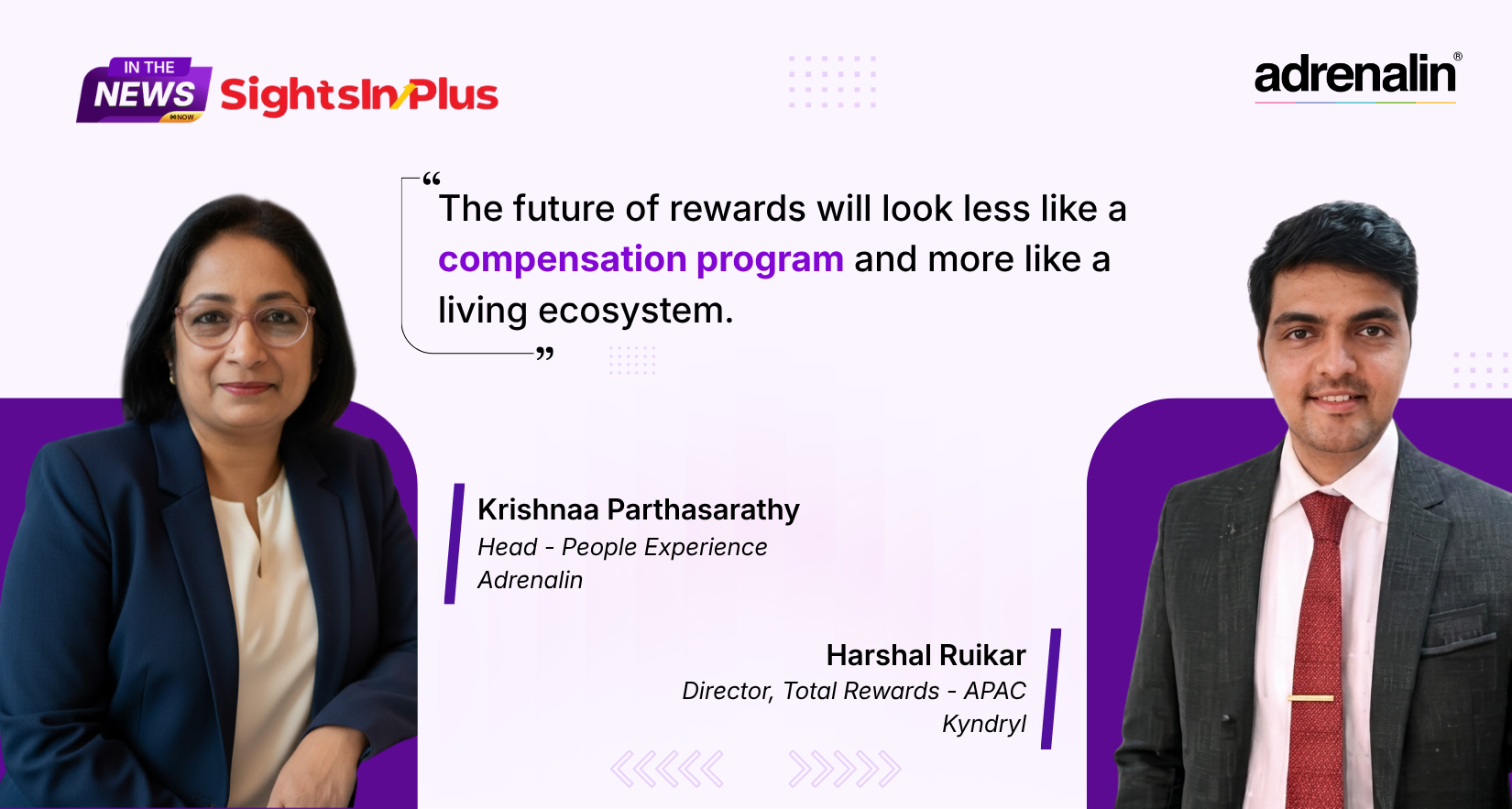
The future of rewards will not resemble rigid compensation structures with occasional bonus overlays. It will look more like a dynamic ecosystem: fluid, responsive, contextual, and adaptive.
Picture this.
A company launches a critical sustainability initiative. Within days, employees across functions begin contributing ideas, solving implementation gaps, and collaborating cross-functionally. AI systems identify meaningful contributions in real time.
Instead of waiting until year-end, incentives begin flowing immediately; micro-bonuses, recognition visibility, access to learning resources, performance scores, and even career opportunities unlock.
Suddenly, motivation becomes kinetic. Recognition no longer sits at the end of the year. It moves with the work itself. This is what fluid incentives look like. But here comes the twist.
Ironically, the future of AI-powered rewards may depend on something deeply human: trust.
Because the moment organizations over-quantify human contribution, systems begin breaking psychologically. Employees are not machines producing measurable outputs every minute. Some of the most important workplace contributions are subtle; like the mentor calming an anxious teammate or the leader absorbing pressure during crisis.
These moments rarely appear on dashboards. And they never fully will.
Which is why the organizations that succeed in the AI era will not blindly automate recognition. They will augment it intelligently. The future is not AI replacing managerial judgment. The future is AI helping organizations notice what humans routinely miss.
That distinction matters enormously.
Delayed recognition in the AI era increasingly feels like organizational deafness. Employees notice it quietly at first, then behaviourally, then emotionally, and eventually through attrition/departure.
Somewhere tonight, inside a global enterprise, another Anika is solving another invisible crisis. She may save a customer relationship, prevent a production outage, unlock innovation, or train an AI workflow that transforms productivity for an entire team.
And tomorrow morning, she will log in hoping that the organization she works for is intelligent enough to know what really happened.
That is the future challenge of Rewards and Recognition. Not merely compensation.
But organizational awareness itself – Contribution Intelligence.
The companies that master this will build workforces that feel seen, energized, and emotionally invested. The companies that do not may continue rewarding visibility over value.
And in the age of AI, that may become one of the costliest mistakes an organization can make.
}', 15='{type=string, value=https://www.sightsinplus.com/magazine/sightsin-plus-june-2026/}'}The Learning & Development Architecture of the Unforeseen
“My experience is what I agree to attend to. Only those items which I notice shape my mind - without selective interest, experience is an utter chaos.” - William James
The transformation was, by all traditional metrics, a success.
The strategy was sound, the capital was allocated, and the L&D function had performed with industrial-grade efficiency. Thousands of employees had moved through the flagship “Enterprise 2.0” curriculum. Completion rates sat at a pristine 98%. The leadership dashboards were a sea of reassuring green.
And yet, six months into execution, the CEO sat in the boardroom with a sobering realization: The organization was standing still.
Despite the certificates and the badges, the workforce was still operating on the logic of the previous decade. The new capabilities, so neatly packaged and delivered, had failed to take root in the soil of daily operation. The enterprise was suffering from a “cognitive lag” that no amount of additional content could bridge.
In that moment of realization, the executive leadership was forced to confront an uncomfortable truth: We cannot install capability like software.
This is the moment L&D ceased being a support function and became a question of enterprise survival. It is the realization that the corporate curriculum, no matter how polished, is a relic of a world that was stable enough to be predictable.
The Predictive Mind: Why Standardization Fails
To understand why that transformation stalled, we must look past the LMS and into the neuroscience of the workforce itself.
As the cognitive philosopher Andy Clark explores in The Experience Machine, we have long misunderstood the human brain. We treated it as a passive vessel to be filled; a window that simply looks out at the world. But Clark reveals that the brain is actually an ever-active prediction engine.
We do not perceive the world as it is; we perceive it as we expect it to be. Our attention is not a neutral lens, but, as William James intuited, an “unapologetic discriminator.”
We blend new sensory input with a nesting doll of selves; the sum of every past experience, bias, and prior success we have ever had. This is the “ghost in the machine” of corporate learning.
Standardization fails because no two employees arrive at a learning event with the same predictive model. One manager hears a lesson on “Agile Decision-Making” and predicts a threat to their autonomy based on fifteen years of hierarchical success. Another hears it and predicts a solution to their daily friction. They are exposed to the same content, but they inhabit entirely different realities.
When we push a standardized curriculum, we are pretending the workforce is a blank slate. By ignoring the individual’s “segment-of-one” predictive model, we ensure that our strategic interventions remain, at best, academic.
The Death of the “Average” Employee
The boardroom lag happens because most organizations are still designing for the “average employee.”
But the average is a statistical fiction. In a world of fluid roles and hyper-specialization, the spread of capability within a single function has widened into a chasm. Two relationship managers in the same office may be miles apart in their readiness for a digital-first strategy; not because of potential, but because of their unique path-dependency.
When we force these two individuals into the same curriculum, we create strategic drag. One is under-challenged; the other is cognitively overwhelmed. Neither updates their internal predictive model.
The boardroom is now demanding a shift from this broadcast model to a narrowcast reality. This is a recognition that the unit of capability is, and always has been, the individual. Capability doesn’t scale through uniformity; it scales through precision.
From Library to Engine
If the brain is a prediction engine, then L&D must stop acting like a library. A library waits for a visitor; it offers content regardless of context. An engine, however, creates power through movement. Today’s CHROs are moving the locus of development away from the “learning event” and into the “flow of work.”
Consider the shift at organizations like IBM or Unilever. They have realized that the most powerful way to update an employee’s internal prediction model is not to show them a video, but to change their context.
By using internal talent marketplaces to match people with gigs and projects that are just beyond their current capability, they are hacking the predictive mind. They are not teaching agility; they are placing people in environments where the only way to resolve cognitive dissonance is to be agile.
As Clark notes, “to perceive is to find the predictions that best fit the sensory evidence.” By changing the evidence (the work), we force the mind to update the prediction (the skill).
In this model, the Work is the Curriculum.
The New Boardroom Mandate
When the CHRO walks into the boardroom today, the conversation has moved past the training budget. It is now about Strategic Readiness.
The Board cares about L&D for one reason: it is the primary lever for de-risking the future. If the strategy pivots on Tuesday, how long does it take for the predictive models of 50,000 employees to catch up?
To answer that, CHROs must speak the language of enterprise design:
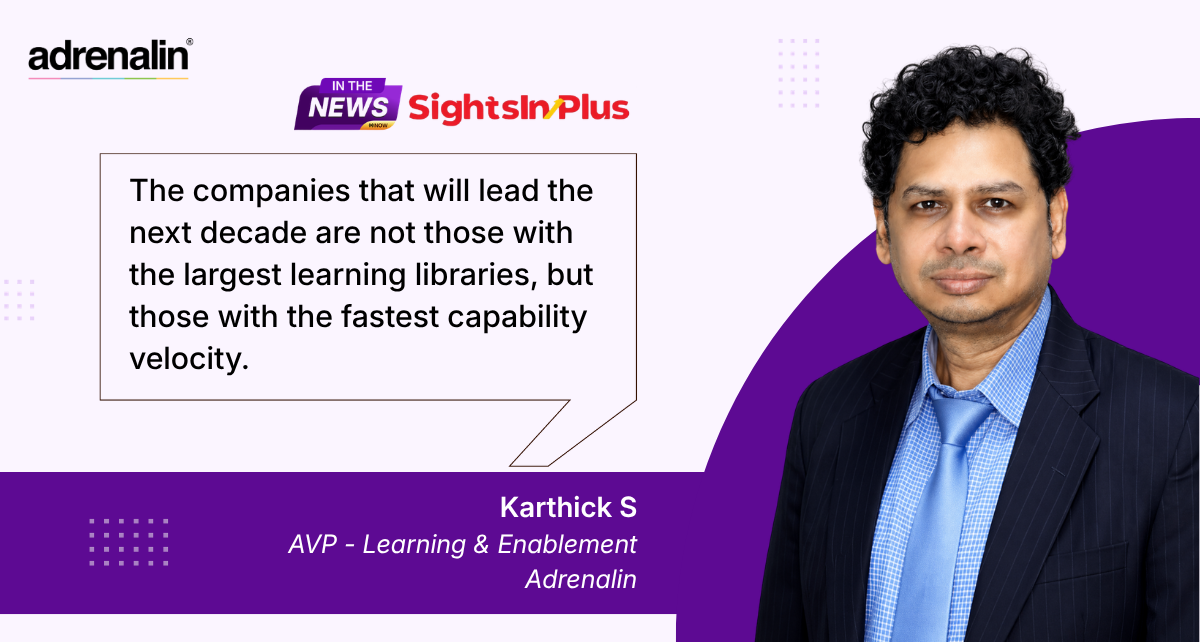
- Capability Velocity: How fast can we shift the workforce’s prediction models in response to a market pivot?
- Internal Redeployment: How effectively are we leveraging the hidden capabilities of our individuals to avoid the high cost of external hiring?
- Cognitive Infrastructure: Are our systems (tools, processes, culture) helping people update their maps, or are they reinforcing old expectations?
Beyond the Curriculum
The story of the stalled transformation eventually found its resolution: the organization succeeded, but only after it stopped trying to “train” its people and started trying to re-architect their experience.
The corporate curriculum is dead because it was designed for stability. And stability is a luxury the modern enterprise no longer possesses.
The future belongs to the CHRO who can build a seething, proactive ocean of prediction where every worker is empowered to update their internal map at the speed of the world around them. The boardroom is no longer interested in the completion of a course. They are waiting for the architecture of the unforeseen.
}', 15='{type=string, value=https://www.sightsinplus.com/insight/learning/the-learning-development-architecture-of-the-unforeseen}'}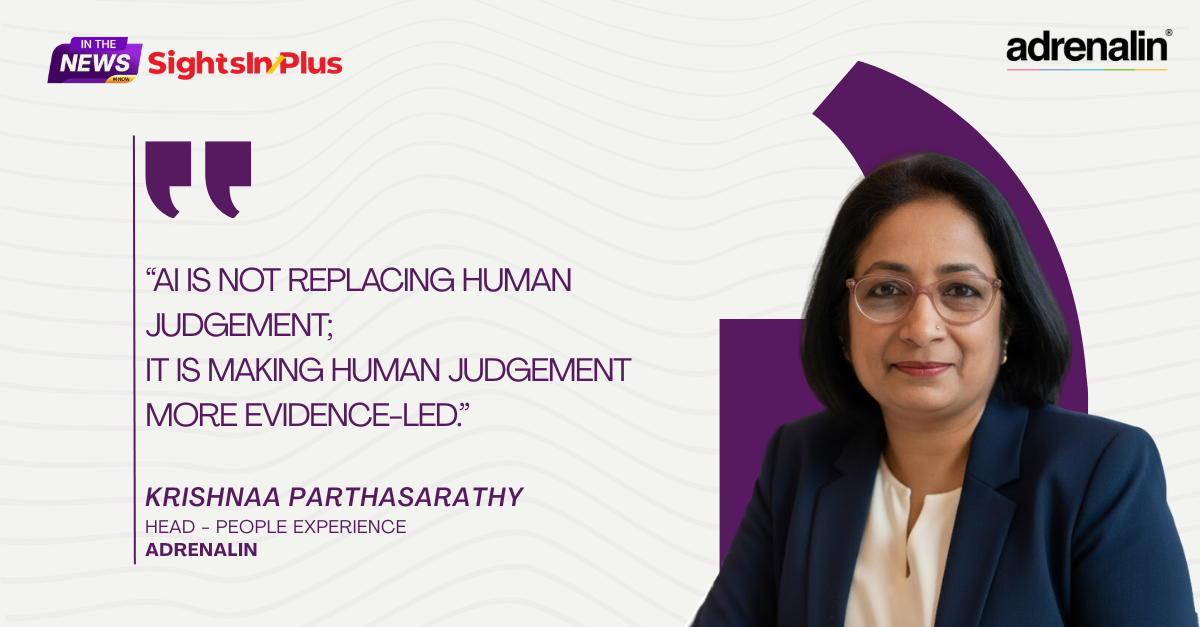
Press Kit

Brand Kit
Download Adrenalin’s logo kit and other brand assets in a zip.
Contact PR team
Contact PR Team and stay connected